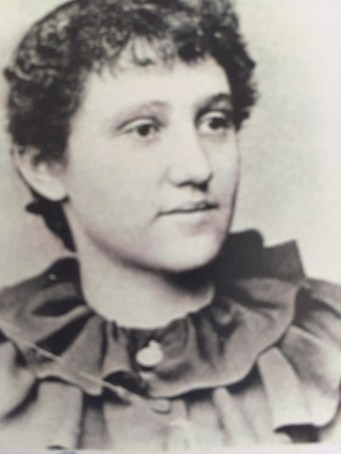
Elizabeth Mary Duffy (1877)

img_2583


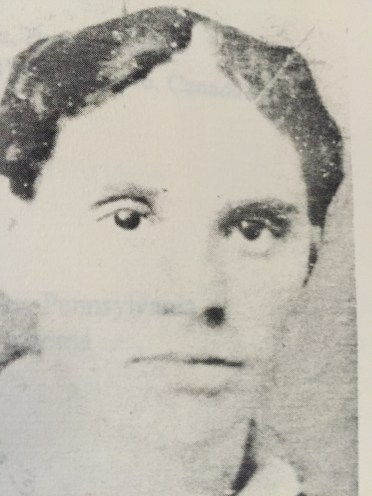
The third child of William George Duffy and Rebecca Smith Duffy was Elizabeth Mary Duffy, who was born in Millerstown Borough, Butler County, Pennsylvania on January 30, 1877. The post office at Millerstown would become known as the  Chicora, Pennsylvania post office in 1891, although it seems Millerstown persisted as the borough’s name for some time after that. The name “Chicora” may have come from a famous legend about a wealthy Native American kingdom sought after by the Spanish after a party of Spanish explorers captured and enslaved a man they named Francisco de Chicora.

Millerstown was part of the Butler County oil boom. In the 1870 census, there were about 200 residents. The borough had a hotel, a tailor shop, a few stores, a blacksmith, stables, and a wagonmaker’s shop. Oil was discovered on two local farms in 1873. As a result, the  population boomed.

It was doubtless this discovery of oil that brought William George Duffy and his wife to Millerstown. The town experienced a major fire in April, 1874. It rebuilt quickly, and by September 1874 the town’s population was over 2,500 and “150 derricks could be seen from the reservoir.”

There were five major fires in Millerstown between 1874 and 1892, one of the biggest in 1877. Elizabeth was not yet a year old when a fire “threatened the whole town.” It started in a tobacco store and took out all of one side of Main Street, destroying 28 buildings.

This was the world she and several of her siblings were born into.

Elizabeth was six years old when her mother died in 1883. Two years later, in 1885, her father remarried. Catherine Mahoney had no children of her own, but raised six children with W.G. Duffy.

On June 21, 1895, when she was 18 years old, Elizabeth married Francis Charles Moriarty, who was 21 years old. It is not clear how they met or where they met, or what Francis’s occupation was at the time. I do know that after they married, the couple lived in the areas where the Moriartys lived, because their two eldest children were born in Pennsylvania, in Foxburg, Clarion County Pennsylvania.It is possible that Francis may have sought work in the oil fields, since he worked in the oil fields after they married, or that William Duffy’s work brought him north of Chicora for a time. Foxburg and Chicora are less than 20 miles apart on today’s roads.
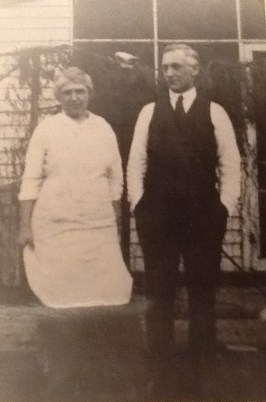
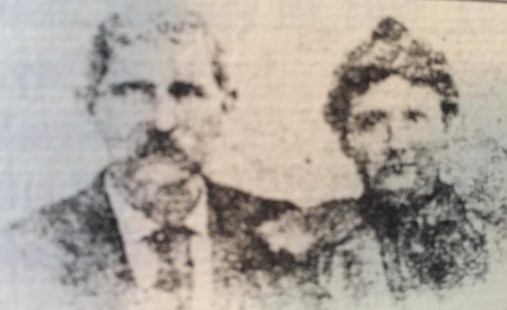
elizabeth-duffy-moriarty-and-francis-moriarty-in-kansas
Elizabeth Duffy Moriarty and Francis C Moriarty, probably in the 1920s

By 1899, the couple was living closer to the Duffys, who by then were in Tyler County, West Virginia. Francis and Elizabeth were in Alvy, Tyler County, West Virginia. This county is just over the Ohio border and is also near the Pennsylvania border. Today, Alvy is part of a nature preserve, although the state has sanctioned new drilling in Tyler County, including on some nature preserves, so it may be home to oil exploration again.

In the 1900 census, Francis was working as a day laborer. Almost all of his neighbors were working on oil wells, so it is likely that he worked on one, too, or in a related industry. This is not surprising, since the oil industry had taken hold in Tyler County before the Civil War, and that was the overwhelmingly dominant industry there at the time. The exact location of where they were living when the 1900 census was counted is: Enumeration District 89: McElroy Magisterial Dist. (part)
Divide the district into two enumeration Magisterial Districts by the following line: Beginning at the mouth of Indian Creek, thence with the dividing ridge between McElroy Creek and Indian Creek to the Doddridge county line and that part of said Magisterial Dist. lying on the waters of Indian Creek shall constitute Enumeration District 89. 
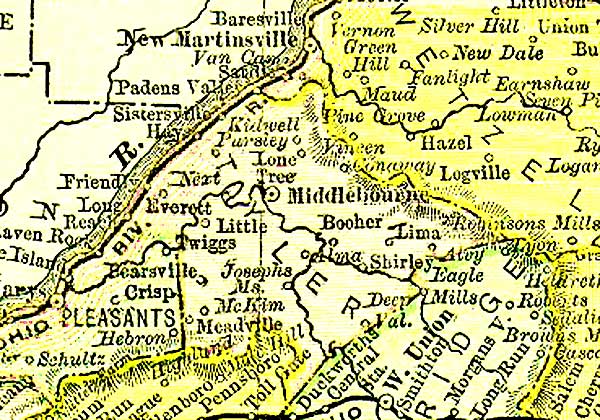
tyler
Tyler County, West Virginia in 1895. Sistersville is near the boldface R. of the Ohio River; Alvy is north of W. Union, just above Eagle Mills.

The couple had nine children over a span of nearly 20 years:

Gertrude Emma Moriarty 1896–1992
Kathryn Rebecca (Kass) Moriarty 1897–1975
Emma Dolores (Sister Carmelita) Moriarty 1899–1993
Edwin Daniel (Ted) Moriarty 1901–1971
Margaret Virginia Moriarty 1905–1983
Julia Marion Moriarty 1907–1998
Francis (Bud) William Moriarty 1911–1984
Wade George Moriarty 1913–1981
Mary Elizabeth Moriarty 1915–1994

By 1910, the family had moved to the Clay District of Harrison County, West Virginia. Francis was working as a laborer in the oil field. Eventually they moved to Adamsville, near Clarksburg, and then to Clarksburg itself. By 1917 they were living at 415 College in Clarksburg, and Francis was working as a planer hand at the Hazel-Atlas Glass Factory.

By 1920, Francis had followed their eldest daughter Gertrude to Augusta, Kansas, where she had stopped off (intending to move to California and live with Doll Duffy; instead she remained in Augusta) to visit Francis’s sister — for whom she was named — Gertrude Moriarty Warnock. Gertrude Warnock’s husband, James Warnock, was working in the oil industry in Augusta — oil had been discovered there in 1914. By the middle of 1916, there were 150 gas wells and 50 oil wells in production in the Augusta field. Francis also obtained work there, and the rest of the family soon boarded a train and joined him. The Moriartys owned a home at 609 Osage there; by 1925 their daughter Gertrude and her husband Herman Fischer were living there with their baby daughter Marjorie; the Moriartys lived in another home in Augusta.

Francis soon got promoted to a job as the superintendent of an oil lease in nearby El Dorado, Kansas. El Dorado’s oil field had produced 9% of the world’s oil during World War I; in 1918 it was the largest producing field in the U.S.; by 1929 over 200 million barrels of oil had been marketed from Butler County wells. In 1934, there were 1,770 wells producing oil in the El Dorado field.

Although Gertrude had married and Emma Dolores (soon to become Sister Carmelita, CSJ) had entered a convent, Elizabeth and their seven other children moved with him to the house on the lease.

Elizabeth and Francis lived on the lease until his death on April 9, 1935.

Elizabeth loved traveling, and in addition to sightseeing also visited each of her adult children. Her “headquarters” were with Francis (Bud) and Ruth Brandon Moriarty, and their daughter Kathryn has many childhood memories of going to the train station to drop off or pick up her grandmother. Ruth Moriarty had lost her own mother at a young age, and was very fond of her mother-in-law, who was good company while Bud was away from home on business trips.

Elizabeth Duffy Moriarty died on August 29, 1951, in Quebec, Canada, while visiting the Catholic Shrine of Ste. Anne De Beaupré with her daughter Sister Carmelita (Emma Dolores).

She is buried next to Francis in Calvary Cemetery in Wichita, Kansas.


Patrick Duffy (b 1812) + Elizabeth Dillon (b 1818)
|
William George Duffy (1846) + Rebecca Smith (1856)
|
Elizabeth Mary Duffy (1877)


Contents of this site, except where noted, are ©2016-2019 by Jan Burke. While I hope you find this site useful in your family history research, please do not copy material you find here onto your Ancestry trees, etc. without permission.

Information presented here is based on my interpretation of the sources I’ve found. As new sources are found or inaccuracies discovered, the site will be updated.

Always happy to hear from cousins.
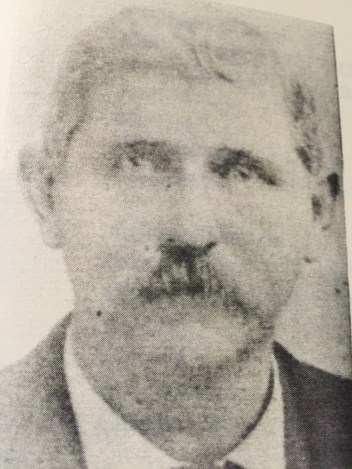
 

William George Duffy (b 1846)

img_2433
William George Duffy

William George Duffy was the second son and fourth of the surviving children of Patrick Duffy and Elizabeth Dillon Duffy. He was born in Lockport, Niagara County, New York on April 6, 1846.

He left home to work in the newly booming Pennsylvania oil industry, probably in about 1866, when he was twenty. By 1869, he was living in the Meadville area, a “laborer” boarding at a place on Washington St in the boom town of Petroleum Center; a James Hogan, a “teamster” boarded there as well — this was probably his brother-in-law. Teamsters were employed in taking the oil from wells to shipping points.

Petroleum Centre is described in the Meadville Directory of 1869 as being located “on Oil Creek, and the Oil Creek and Allegheny River Railroad, and is a town of much importance in the Oil Producing Districts. It is situated about seven miles from Oil City and five miles from Titusville. In the town and surrounding farms are some of the most productive wells in the Oil Region.” Its population was about 4,000.

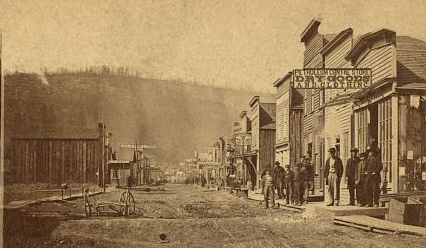
While the Directory paints a typically rosy picture of the place, saying “the town bears the name of a quiet and industrious people,” the local paper, the Petroleum Center Daily Recordreported the sort of carrying on one might expect in a boom town — assaults, murders, fortunes lost, and some made. And no shortage of saloons. On this website, which seems to have used a photo of a page from an unidentified book, a wild and rough place is portrayed; the photo is of the street where William G. Duffy lived.

This photo, from the Library of Congress, is from a stereograph image of Petroleum Center’s Main Street. This is from about 1860, and Petroleum Center was probably a little less built up than when William G. Duffy arrived.

PetroleumCenterPA1800s-2

Today the town is all but deserted, one of the ghost towns of Pennsylvania’s oil boom.

By the 1870 census, William G Duffy was in Oil City, Pennsylvania, working as an “engineer on [an oil] well.”  He lived in a boarding house with about fifteen other people, mostly men. The three women were a servant, the wife of the owner, and the wife of a teamster.

“Engineer on an oil well” indicates that he was already experienced on oil rigs, although at this point in history petroleum engineering was a relatively new field, and not as we think of it — it was, as one study (Giebelhaus, 1996) says, “predominantly craft-based and ad hoc.” The same study notes that in the U.S., crude oil production increased from “only 2,000 barrels in 1859 to 4,800,000 barrels in 1869 and 5,350,000 in 1871.” The immediate center for this growth was Western Pennsylvania, and William George Duffy was there almost from the start.

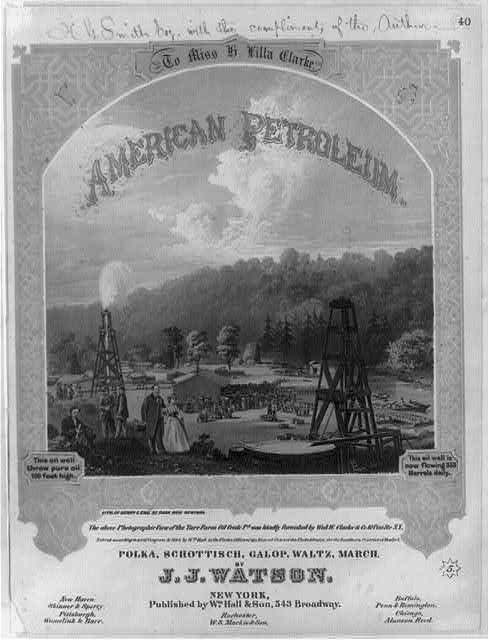
Music with cover lithograph of Tarr Farm, OIl City PA

This sheet music cover from about 1864 features a lithograph of the Tarr Farm, Oil City, Pennsylvania. (from the Library of Congress.)

img_2434
Rebecca Smith

In 1874, he married Rebecca Smith, whose father, J.T. Smith, was an Irish immigrant and harness maker. Her mother, Margaret Redick Smith, was descended from a family who had been in western Pennsylvania from colonial days. J.T. Smith’s work led to travel throughout the boomtown areas. (The last thirteen years of his life were spent in Marienville, Pennsylvania, where the Moriarty family also settled.)  William G. Duffy married Rebecca in Buena Vista, Pennsylvania. Buena Vista was part of Butler County at that time.

They had six children, five of whom survived infancy:

George Patrick Duffy 1874–1874
Emma Delores (Doll) Duffy 1875–1960
Elizabeth Mary Duffy 1877–1951
James Francis Duffy 1878–1964
William George (Wade) Duffy Jr 1881–1957
Rebecca Marie (Ruby) Duffy 1882–1949

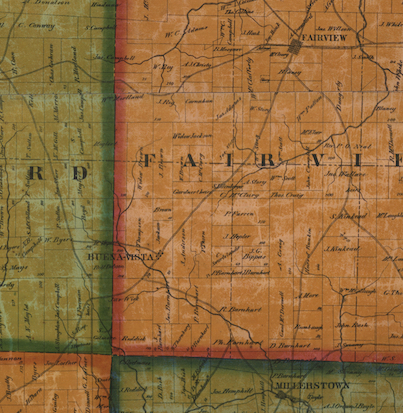
Their first two children were born in Buena Vista.

Buena Vista Fairview Millerstown PA 1858
Buena Vista is below the “F” in FAIRVIEW; Millerstown is below the R in the next township to the south; Fairview itself is north of the R.Map is from 1858; these areas were soon more heavily populated as a result of the oil boom.

The next three children were born in Chicora, Pennsylvania. Chicora was a later name for the post office for Millerstown, although the borough name of Millerstown remained for some time. At the time of their births, it was probably called Millerstown.

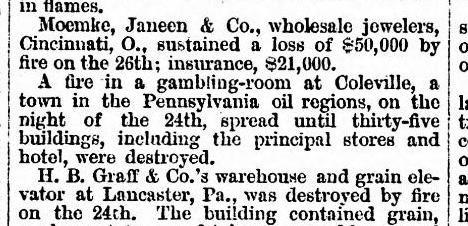
The youngest, Ruby, was born in Coleville*, Pennsylvania. Although you can’t find it on maps now, Coleville was near Aiken and Rew, Pennsylvania, an oil producing area, part of the Bradford field. It is nearer the PA/NY border than the other towns. Coleville  suffered heavy losses in an November 1880 fire, as this story in a Minnesota paper mentioned:

Fire in Coleville 24 Nov 1880 from Minn newspaper

By the 1880 census, William is listed as an “oil producer,” meaning he owned an interest in at least one well.  I’ve found an 1877 article mentioning that “Duffy and Hogan” had a well near Millerstown “showing promise.” Not enough detail to be sure it’s the same men, but it’s a possibility.

At this point in time, the only two siblings not living near William were John, who still lived in Lockport near their mother, and recently widowed Elizabeth, who probably had been living there shortly before the census was taken. Margaret, her husband Francis Duffy, and their two young children lived next door to James and Mary Hogan, who were caring for Willie Westerman, the son of Elizabeth Duffy Westerman. On the other side of the Hogans were William and Rebecca and their three children. James Hogan is also listed as an oil producer, and Francis Duffy as an oil pumper, meaning someone who worked on the well.

On December 31, 1883, Rebecca died of typhoid fever in Coleville*, Pennsylvania.

William brought her to Lockport to be buried near his parents, in the Duffy family plot in St Patrick’s cemetery. At thirty-seven, he was a widower with five children, the oldest of them eight years old.

img_2436
William George Duffy and Catherine Mahoney Duffy

Two years later, in 1885, he married Catherine Mahoney. I have believed the couple had one child together, John Daniel Duffy, born in 1892, but this is a little uncertain — in the 1900 and 1910 censuses she stated that she had not borne any children. So he may have been adopted. I’m looking into that, and also trying to verify some of the previous information I had on Catherine.

By 1900, William was a foreman on the Eureka Oil Pipeline. The family had by then moved to Tyler County, West Virginia. The only two children still at home were William Jr. and John Daniel.

William was on a business trip to Cambridge Springs, Pennsylvania in 1909 when he died of pneumonia on September 4, 1909. A notation on his death certificate states that he contracted the illness in Sistersville, West Virginia, his usual place of residence, and that his body was sent to Sistersville for burial. I have not yet located his grave.

Catherine remained in Tyler County for at least another year. I do not yet know her date or place of death.

*This may have been Coyleville, another oil town in Butler County. I’m looking into this possibility.


Sources include:

Giebelhaus, August W.. 1996. “THE EMERGENCE OF THE DISCIPLINE OF PETROLEUM ENGINEERING: AN INTERNATIONAL COMPARISON”. Icon 2. Temporary Publisher: 108–22. http://www.jstor.org/stable/23790403.

Mower County transcript. (Lansing, Minn.) 1868-1915, December 01, 1880, Image 1Image provided by Minnesota Historical Society; Saint Paul, MN
Persistent link: http://chroniclingamerica.loc.gov/lccn/sn85025431/1880-12-01/ed-1/seq-1/

Regarding the establishment of Chicora: http://www.rootsweb.ancestry.com/~pabutler/1895/95×43.htm


Contents of this site, except where noted, are ©2016-2019 by Jan Burke. While I hope you find this site useful in your family history research, please do not copy material you find here onto your Ancestry trees, etc. without permission.

Information presented here is based on my interpretation of the sources I’ve found. As new sources are found or inaccuracies discovered, the site will be updated.

Always happy to hear from cousins.
Elizabeth Dillon (b 1818)

Elizabeth Dillon was born in Ireland in about 1818. This date of birth is based on census records and information on her gravestone. She came to the U.S. sometime before 1938. We are not sure whether she met her husband, Patrick Duffy, in Ireland or the U.S..

After the birth of their first son, John, the Duffys moved to Lockport and stayed there all their lives.

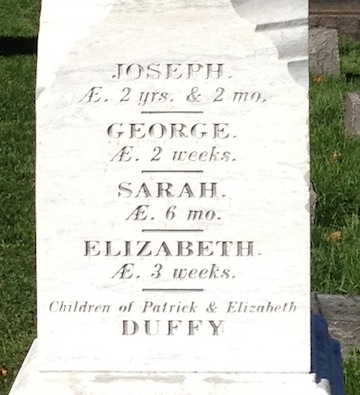
Patrick and Elizabeth Duffy had nine children, three of whom died in infancy and one who died as a young child.  You can read their names and ages here.

The other five survived to adulthood:

John Duffy (b 1838)

Mary A. Duffy (b 1841)

Elizabeth Duffy (b 1844)

William George Duffy (b 1846)

Margaret J. Duffy (b 1850)

After her husband Patrick died in 1879, her widowed daughter Elizabeth Duffy Westerman and Elizabeth’s daughter, Mary Westerman moved with her at 277 Glenwood in Lockport.

William Westerman, a son of Elizabeth Westerman Duffy, was living with his aunt Mary Duffy Hogan in Fairview, Pennsylvania in 1880, but returned to Lockport before his death in 1885.

When her daughter Elizabeth remarried in 1888, Elizabeth Dillon Duffy moved with her daughter and granddaughter to the Northern Hotel at 297 Gooding, owned by her new son-in-law, Charles Scheffer.

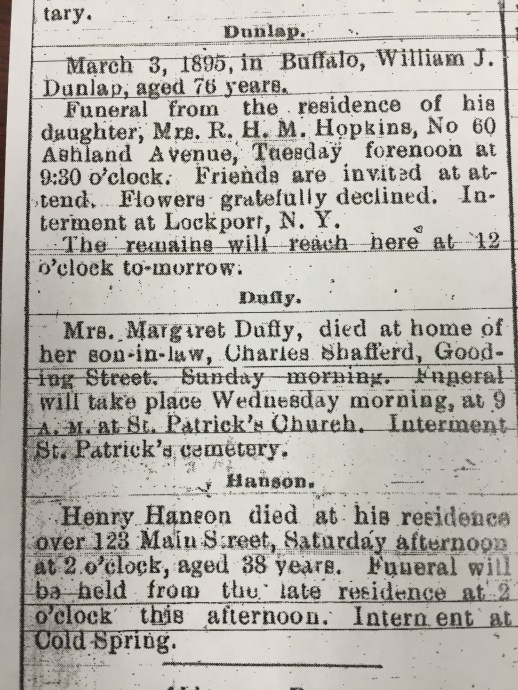
Elizabeth Dillon died on March 3, 1895. She is buried in St Patrick’s Catholic Cemetery in Lockport.

The obituary below, from the Lockport Union, misstated her first name, perhaps mixing it up with her daughter’s name, and misspelled her son-in-law’s name.

img_2040
Lockport Union notice of Elizabeth Dillon Duffy’s death.

Contents of this post ©2016 Jan Burke

Among others, sources for this post include:

“United States Census, 1840” Lockport, Niagara, New York, Roll 311, Page 63 Image 131; FHL Film 0017199

“New York State Census, 1855,” database with images, FamilySearch (https://familysearch.org/pal:/MM9.3.1/TH-1961-25918-9964-36?cc=1937366 : accessed 7 May 2016), Niagara > Lockport, E.D. 1 > image 5 of 43; county clerk offices, New York.

“United States Census, 1860”, database with images, FamilySearch (https://familysearch.org/ark:/61903/1:1:MCWJ-GPX : accessed 7 May 2016), Pat Duffy, 1860.

“New York State Census, 1865,” database with images, FamilySearch (https://familysearch.org/pal:/MM9.3.1/TH-267-13031-126099-13?cc=1491284 : accessed 7 May 2016), Niagara > Lockport, E.D. 01 > image 3 of 52; State Library, Albany.

“United States Census, 1870,” 1st Ward, Lockport, Niagara County, New York, page 88, lines 1-3; census taken 28 June 1870. (Accessed 7 May 2016) http://search.ancestry.com/cgi-bin/sse.dll?db=1870usfedcen&h=31519124&ti=0&indiv=try&gss=pt

“United States Census, 1880,” Lockport, Niagara County, New York, Supervision District 11, Enumeration District, 197. Image number 467. page 39, lines 44-46; census taken 14 June 1870. (Accessed 8 May 2016) http://search.ancestry.com/cgi-bin/sse.dll?db=1880usfedcen&h=4462571&ti=0&indiv=try&gss=pt


Contents of this site, except where noted, are ©2016-2019 by Jan Burke. While I hope you find this site useful in your family history research, please do not copy material you find here onto your Ancestry trees, etc. without permission.

Information presented here is based on my interpretation of the sources I’ve found. As new sources are found or inaccuracies discovered, the site will be updated.

Always happy to hear from cousins.
Patrick Duffy (b 1812)

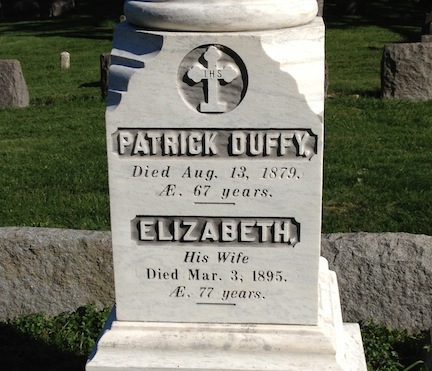
Patrick* Duffy was born in Ireland in about 1812. This date is based on census answers and the inscription on the memorial at his gravesite, which states that he was 67 when he died in 1879.

He married Elizabeth Dillon, who was also born in Ireland.

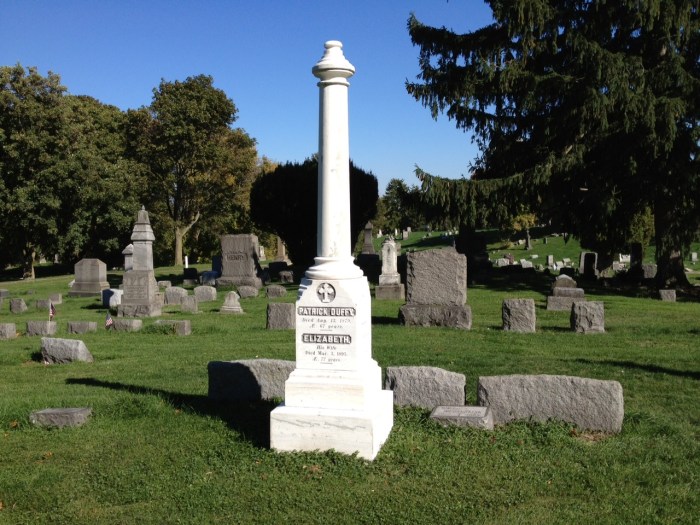
photo
Duffy Family Memorial Monument and Gravestones, located in St Patrick’s Cemetery, Lockport, New York
Close up Patrick and Elizabeth Duffy
Detail of Duffy Family Monument, Patrick Duffy and Elizabeth Dillon Duffy.


We are not yet sure whether they married in Ireland or the U.S., but they were probably married around 1837, since their first child, John, was born in 1838.

That John was born in New York tells us that the Duffys came to the U.S. by at least 1838, and perhaps earlier. The Duffys first settled in Orleans County, New York, but soon moved to Lockport, Niagara County, New York, where the couple would spend the rest of their lives.

Patrick Duffy and his family are listed in the 1840 federal census in Lockport, Niagara County, New York. At that time, no name other than the head of household was listed, but judging by the ages of the other household members, the family consisted of Patrick, Elizabeth, and John.

In the 1850 federal census, Patrick’s occupation is listed as “lab[orer].” He owned land worth $500 and could read and write.

The family had grown — the children listed are John, Mary, Elizabeth and William. By the end of that year another child, Margaret, was born.

From the inscriptions shown below memorial monument/gravestone in St Patrick’s Cemetery in Lockport that other children — Joseph, George, Sarah, and Elizabeth — were born to the couple but did not survive childhood. It is most likely that this infant Elizabeth was born before the surviving daughter of that name.

closeup children's names
Children of Patrick and Elizabeth Duffy who did not survive infancy or early childhood.


So the five surviving children were:

John Duffy (b 1838)

Mary A. Duffy (b 1841)

Elizabeth Duffy (b 1844)

William George Duffy (b 1846)

Margaret J. Duffy (b 1850)

The 1855 state census shows that Orleans County was the birthplace of John Duffy, which is how we know Patrick, Elizabeth, and John lived there at one point. All the other children were born in Lockport.

Patrick is also listed as a laborer in this census. At 15, John was farming the home land.

In the 1860 federal census, his occupation is listed as “drayman.” Historically, this was a person who owned a low wagon without sides. Drays were drawn by horses or mules, and used for transporting goods to and from a port. Lockport, on the Erie Canal, would have had plenty of work for a drayman.

By that year, his son John had married and moved away to his own home.

In 1860 Patrick’s land was worth $1000 and his personal property worth $300. In the 1865 New York State Census, he was working as a laborer — probably still as a drayman.

An 1868 Lockport City Directory lists his occupation as “junk dealer.” The directory says that he lives on Glenwood near Lock Street.

By 1870, when he was 58, he was listed in the census as a farmer. His land was worth $3000, his personal property $500. Only his wife, Elizabeth, and their two youngest daughters lived at home.

The 1871 Lockport City Directory lists his occupation as “peddler.” As in previous records, the family home was on Glenwood.

On August 13, 1879, Patrick died in Lockport. He was 67 years old. His cause of death is listed as “soft of the brain” in a mortality census for New York state. This is probably a shortened version of “softening of the brain,” or encephalomalacia. One online source for archaic medical terms, Old Disease Names by Sylvain Cazalet, says “softening of the brain” was the “result of stroke or hemorrhage in the brain, with an end result of the tissue softening in that area.” The attending physician was Dr. Gallagher. The death record indicates that he had been a resident of the county for 42 years. The brief time in Orleans County was probably added in to that number.

Patrick Duffy is buried in St. Patrick’s Catholic Cemetery in Lockport, New York.


*Although some family histories list him as William Patrick Duffy, in census and other records he is simply known as Pat or Patrick Duffy.


Contents of this post and all others on this site ©2016 Jan Burke


Among others, sources for this post include:

“United States Census, 1840” Lockport, Niagara, New York, Roll 311, Page 63 Image 131; FHL Film 0017199

“New York State Census, 1855,” database with images, FamilySearch (https://familysearch.org/pal:/MM9.3.1/TH-1961-25918-9964-36?cc=1937366 : accessed 7 May 2016), Niagara > Lockport, E.D. 1 > image 5 of 43; county clerk offices, New York.

“United States Census, 1860,” database with images, FamilySearch (https://familysearch.org/ark:/61903/1:1:MCWJ-GPX : accessed 7 May 2016), Pat Duffy, 1860.

“New York State Census, 1865,” database with images, FamilySearch (https://familysearch.org/pal:/MM9.3.1/TH-267-13031-126099-13?cc=1491284 : accessed 7 May 2016), Niagara > Lockport, E.D. 01 > image 3 of 52; State Library, Albany.

“United States Census, 1870,” 1st Ward, Lockport, Niagara County, New York, page 87, line 40; census taken 28 June 1870. (Accessed 7 May 2016) http://search.ancestry.com/cgi-bin/sse.dll?db=1870usfedcen&h=31519124&ti=0&indiv=try&gss=pt

“U.S. Federal Census Mortality Schedules, 1850-1885” 1880, Enumeration District 197, Line 24. (Accessed 7 May 2016)


Photographs of Duffy gravestones and memorial monument in St. Patrick’s Cemetery, Lockport, New York. All photographs ©2012 by Jan Burke

Please note that information posted on this site may change as new sources are discovered. 


Contents of this site, except where noted, are ©2016-2019 by Jan Burke. While I hope you find this site useful in your family history research, please do not copy material you find here onto your Ancestry trees, etc. without permission.

Information presented here is based on my interpretation of the sources I’ve found. As new sources are found or inaccuracies discovered, the site will be updated.

Always happy to hear from cousins.