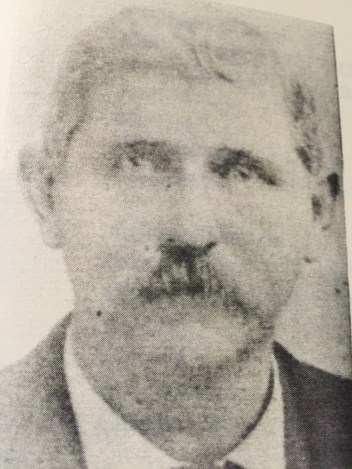
William George Duffy was the second son and fourth of the surviving children of Patrick Duffy and Elizabeth Dillon Duffy. He was born in Lockport, Niagara County, New York on April 6, 1846.
He left home to work in the newly booming Pennsylvania oil industry, probably in about 1866, when he was twenty. By 1869, he was living in the Meadville area, a “laborer” boarding at a place on Washington St in the boom town of Petroleum Center; a James Hogan, a “teamster” boarded there as well — this was probably his brother-in-law. Teamsters were employed in taking the oil from wells to shipping points.
Petroleum Centre is described in the Meadville Directory of 1869 as being located “on Oil Creek, and the Oil Creek and Allegheny River Railroad, and is a town of much importance in the Oil Producing Districts. It is situated about seven miles from Oil City and five miles from Titusville. In the town and surrounding farms are some of the most productive wells in the Oil Region.” Its population was about 4,000.
While the Directory paints a typically rosy picture of the place, saying “the town bears the name of a quiet and industrious people,” the local paper, the Petroleum Center Daily Record, reported the sort of carrying on one might expect in a boom town — assaults, murders, fortunes lost, and some made. And no shortage of saloons. On this website, which seems to have used a photo of a page from an unidentified book, a wild and rough place is portrayed; the photo is of the street where William G. Duffy lived.
This photo, from the Library of Congress, is from a stereograph image of Petroleum Center’s Main Street. This is from about 1860, and Petroleum Center was probably a little less built up than when William G. Duffy arrived.
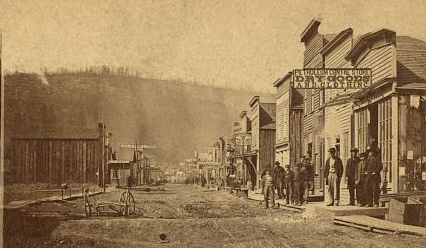
Today the town is all but deserted, one of the ghost towns of Pennsylvania’s oil boom.
By the 1870 census, William G Duffy was in Oil City, Pennsylvania, working as an “engineer on [an oil] well.” He lived in a boarding house with about fifteen other people, mostly men. The three women were a servant, the wife of the owner, and the wife of a teamster.
“Engineer on an oil well” indicates that he was already experienced on oil rigs, although at this point in history petroleum engineering was a relatively new field, and not as we think of it — it was, as one study (Giebelhaus, 1996) says, “predominantly craft-based and ad hoc.” The same study notes that in the U.S., crude oil production increased from “only 2,000 barrels in 1859 to 4,800,000 barrels in 1869 and 5,350,000 in 1871.” The immediate center for this growth was Western Pennsylvania, and William George Duffy was there almost from the start.
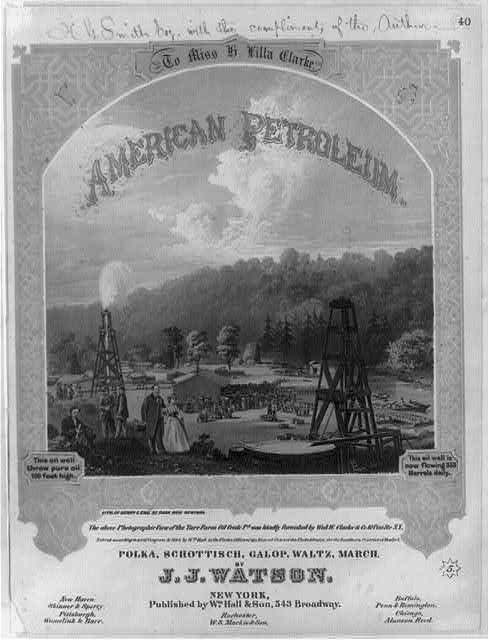
This sheet music cover from about 1864 features a lithograph of the Tarr Farm, Oil City, Pennsylvania. (from the Library of Congress.)
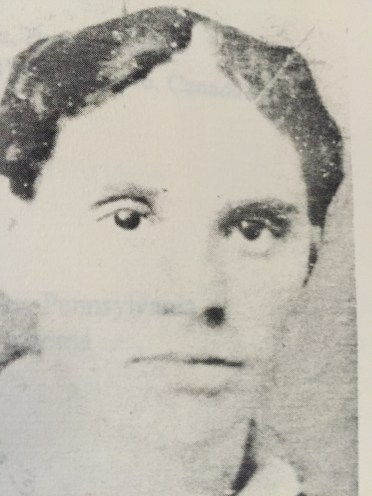
In 1874, he married Rebecca Smith, whose father, J.T. Smith, was an Irish immigrant and harness maker. Her mother, Margaret Redick Smith, was descended from a family who had been in western Pennsylvania from colonial days. J.T. Smith’s work led to travel throughout the boomtown areas. (The last thirteen years of his life were spent in Marienville, Pennsylvania, where the Moriarty family also settled.) William G. Duffy married Rebecca in Buena Vista, Pennsylvania. Buena Vista was part of Butler County at that time.
They had six children, five of whom survived infancy:
George Patrick Duffy 1874–1874
Emma Delores (Doll) Duffy 1875–1960
Elizabeth Mary Duffy 1877–1951
James Francis Duffy 1878–1964
William George (Wade) Duffy Jr 1881–1957
Rebecca Marie (Ruby) Duffy 1882–1949
Their first two children were born in Buena Vista.
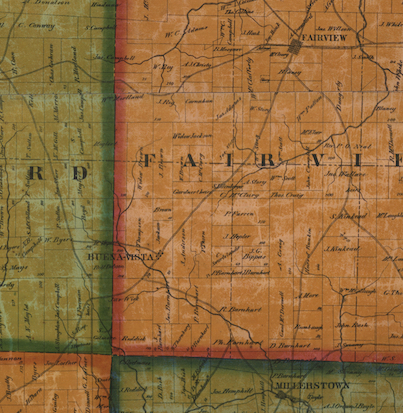
The next three children were born in Chicora, Pennsylvania. Chicora was a later name for the post office for Millerstown, although the borough name of Millerstown remained for some time. At the time of their births, it was probably called Millerstown.
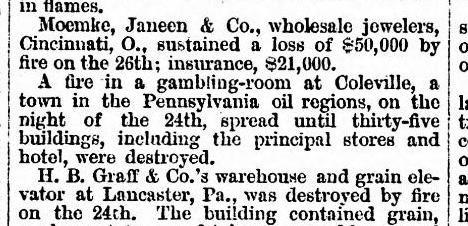
The youngest, Ruby, was born in Coleville*, Pennsylvania. Although you can’t find it on maps now, Coleville was near Aiken and Rew, Pennsylvania, an oil producing area, part of the Bradford field. It is nearer the PA/NY border than the other towns. Coleville suffered heavy losses in an November 1880 fire, as this story in a Minnesota paper mentioned:
By the 1880 census, William is listed as an “oil producer,” meaning he owned an interest in at least one well. I’ve found an 1877 article mentioning that “Duffy and Hogan” had a well near Millerstown “showing promise.” Not enough detail to be sure it’s the same men, but it’s a possibility.
At this point in time, the only two siblings not living near William were John, who still lived in Lockport near their mother, and recently widowed Elizabeth, who probably had been living there shortly before the census was taken. Margaret, her husband Francis Duffy, and their two young children lived next door to James and Mary Hogan, who were caring for Willie Westerman, the son of Elizabeth Duffy Westerman. On the other side of the Hogans were William and Rebecca and their three children. James Hogan is also listed as an oil producer, and Francis Duffy as an oil pumper, meaning someone who worked on the well.
On December 31, 1883, Rebecca died of typhoid fever in Coleville*, Pennsylvania.
William brought her to Lockport to be buried near his parents, in the Duffy family plot in St Patrick’s cemetery. At thirty-seven, he was a widower with five children, the oldest of them eight years old.
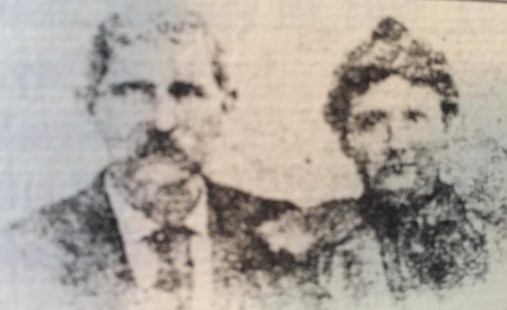
Two years later, in 1885, he married Catherine Mahoney. I have believed the couple had one child together, John Daniel Duffy, born in 1892, but this is a little uncertain — in the 1900 and 1910 censuses she stated that she had not borne any children. So he may have been adopted. I’m looking into that, and also trying to verify some of the previous information I had on Catherine.
By 1900, William was a foreman on the Eureka Oil Pipeline. The family had by then moved to Tyler County, West Virginia. The only two children still at home were William Jr. and John Daniel.
William was on a business trip to Cambridge Springs, Pennsylvania in 1909 when he died of pneumonia on September 4, 1909. A notation on his death certificate states that he contracted the illness in Sistersville, West Virginia, his usual place of residence, and that his body was sent to Sistersville for burial. I have not yet located his grave.
Catherine remained in Tyler County for at least another year. I do not yet know her date or place of death.
*This may have been Coyleville, another oil town in Butler County. I’m looking into this possibility.
Sources include:
Giebelhaus, August W.. 1996. “THE EMERGENCE OF THE DISCIPLINE OF PETROLEUM ENGINEERING: AN INTERNATIONAL COMPARISON”. Icon 2. Temporary Publisher: 108–22. http://www.jstor.org/stable/23790403.
Mower County transcript. (Lansing, Minn.) 1868-1915, December 01, 1880, Image 1Image provided by Minnesota Historical Society; Saint Paul, MN
Persistent link: http://chroniclingamerica.loc.gov/lccn/sn85025431/1880-12-01/ed-1/seq-1/
Regarding the establishment of Chicora: http://www.rootsweb.ancestry.com/~pabutler/1895/95×43.htm
Contents of this site, except where noted, are ©2016-2019 by Jan Burke. While I hope you find this site useful in your family history research, please do not copy material you find here onto your Ancestry trees, etc. without permission.
Information presented here is based on my interpretation of the sources I’ve found. As new sources are found or inaccuracies discovered, the site will be updated.
Always happy to hear from cousins.
 Duffy Family History
10 thoughts on “William George Duffy (b 1846)”